
If you’re hosting web content for customers around the world in multiple languages, you’ll need to consider your url structure. There are several different options, each with implications for your customer experience and global SEO strategy.
In this article we’ll examine each option, what they involve and their pros and cons.
Let’s start with the basics and look at the elements that make up a url.
What is a url?
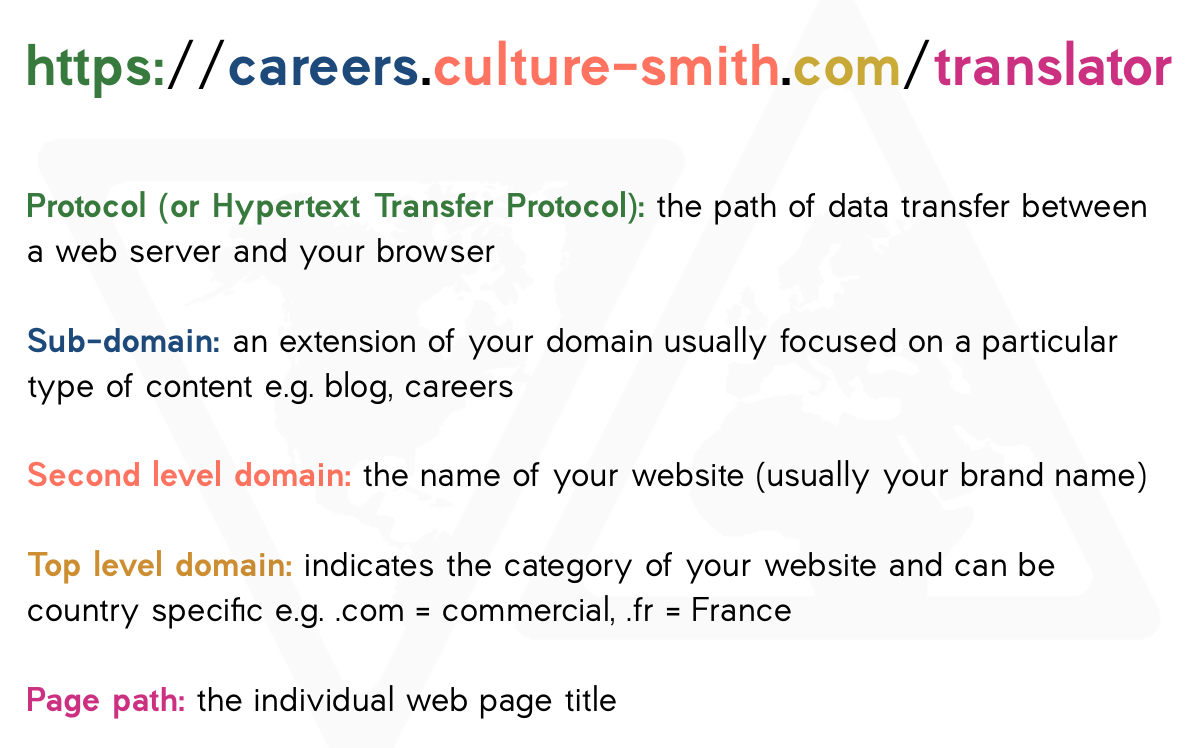
The image below shows the different elements that make up a url.
Next, let’s consider the three different options for hosting different language versions of your website.
Sub-folders
e.g. culture-smith.com/fr
A sub-folder or sub-directory is used to house a specific set of content e.g. French content on your main site.
Advantages of sub-folders:
- SEO authority: Sub-folders benefit from the credibility and authority earned by your main site.
- Low lift: Sub-folders are likely to be the easiest international url structure to maintain and update
Disadvantages of sub-folders:
- Trust: Consumers in some countries may prefer to visit sites with a local top level domain e.g. .fr rather than .com
Sub-domains
A sub-domain can be used to create a separate and distinct part of your site where users have a unique experience aligned with their particular intent e.g. to read your blog or to apply for a job at your company.
When it comes to website localisation different sub-domains could be used to host content in different languages. In that scenario, your url structure would look something like this: fr.culture-smith.com (French), de.culture-smith.com (German)
Advantages of using sub-domains
- Customisation: Individual sub-domains can have a distinct look, feel and layout. This means that you can create unique experiences for customers in different regions based on their behaviour and preferences, product availability, shipping options etc.
- Low cost: Creating sub-domains is cheaper than purchasing country specific domains
- User experience: Sub-domains enable you to keep your content well organised, easily navigable and uncluttered. This leads to a better user experience which in turn can boost engagement and conversion.
- Global SEO: Sub-domains can be optimised for SEO separately from your domain. In terms of localisation, that allows your different sub-domains to rank for different language specific keywords.
Disadvantages of sub-domains
- SEO authority: The SEO authority commanded by your main domain will not be shared with your individual sub-domains. Each sub-domain will have to earn its own SEO ranking.
Country code top level domains (ccTLDs)
A ccTLD or country code top level domain requires purchasing a separate domain to your main site. They are used to target a specific country or region (not a language).
So, for example you might have the following domains: culture-smith.de (de_DE content), culture-smith.fr (fr_FR content)
Advantages of using ccTLDs
- Trust: Consumers in some countries may trust a site with a local domain more than a .com site. In some regions you may actually require a ccTLD in order to trade.
- Customisation: As with sub-domains, you’ll benefit from the ability to customise and optimise your content freely for each region without the risk of cannibalisation.
Disadvantages of using ccTLDs
- Cost: The main downside to using multiple ccTLDs is the cost involved in purchasing and maintaining multiple domains.
- SEO authority: Each ccTLD will require its own SEO strategy to build up its own domain authority.
- Restrictions: In some cases, your business must be registered in a specific country in order to be able to purchase the relevant ccTLD.
There’s no one-size-fits-all approach to choosing an international url structure.
Ultimately, the right choice for your brand will depend on your own business priorities, resources, the locations you’re targeting and your content offering.
To chat more about website localisation, including global SEO strategy, reach out to us today.
If you’re hosting web content for customers around the world in multiple languages, you’ll need to consider your url structure. There are several different options, each with implications for your customer experience and global SEO strategy.
In this article we’ll examine each option, what they involve and their pros and cons.
Let’s start with the basics and look at the elements that make up a url.
What is a url?
The image below shows the different elements that make up a url.
Next, let’s consider the three different options for hosting different language versions of your website.
Sub-folders
e.g. culture-smith.com/fr
A sub-folder or sub-directory is used to house a specific set of content e.g. French content on your main site.
Advantages of sub-folders:
- SEO authority: Sub-folders benefit from the credibility and authority earned by your main site.
- Low lift: Sub-folders are likely to be the easiest international url structure to maintain and update
Disadvantages of sub-folders:
- Trust: Consumers in some countries may prefer to visit sites with a local top level domain e.g. .fr rather than .com
Sub-domains
A sub-domain can be used to create a separate and distinct part of your site where users have a unique experience aligned with their particular intent e.g. to read your blog or to apply for a job at your company.
When it comes to website localisation different sub-domains could be used to host content in different languages. In that scenario, your url structure would look something like this: fr.culture-smith.com (French), de.culture-smith.com (German)
Advantages of using sub-domains
- Customisation: Individual sub-domains can have a distinct look, feel and layout. This means that you can create unique experiences for customers in different regions based on their behaviour and preferences, product availability, shipping options etc.
- Low cost: Creating sub-domains is cheaper than purchasing country specific domains
- User experience: Sub-domains enable you to keep your content well organised, easily navigable and uncluttered. This leads to a better user experience which in turn can boost engagement and conversion.
- Global SEO: Sub-domains can be optimised for SEO separately from your domain. In terms of localisation, that allows your different sub-domains to rank for different language specific keywords.
Disadvantages of sub-domains
- SEO authority: The SEO authority commanded by your main domain will not be shared with your individual sub-domains. Each sub-domain will have to earn its own SEO ranking.
Country code top level domains (ccTLDs)
A ccTLD or country code top level domain requires purchasing a separate domain to your main site. They are used to target a specific country or region (not a language).
So, for example you might have the following domains: culture-smith.de (de_DE content), culture-smith.fr (fr_FR content)
Advantages of using ccTLDs
- Trust: Consumers in some countries may trust a site with a local domain more than a .com site. In some regions you may actually require a ccTLD in order to trade.
- Customisation: As with sub-domains, you’ll benefit from the ability to customise and optimise your content freely for each region without the risk of cannibalisation.
Disadvantages of using ccTLDs
- Cost: The main downside to using multiple ccTLDs is the cost involved in purchasing and maintaining multiple domains.
- SEO authority: Each ccTLD will require its own SEO strategy to build up its own domain authority.
- Restrictions: In some cases, your business must be registered in a specific country in order to be able to purchase the relevant ccTLD.
There’s no one-size-fits-all approach to choosing an international url structure.
Ultimately, the right choice for your brand will depend on your own business priorities, resources, the locations you’re targeting and your content offering.
To chat more about website localisation, including global SEO strategy, reach out to us today.
Related Posts

From planet to people, someone's always paying the cost of AI translation.

A look at sensitivity in translation, how errors can occurr and how to avoid them.

Discover how to localise email campaigns as part of an international marketing strategy.
